Weaving Knowledge: Indigenous Research Gathering Invites Dialogue on Food, Land, Community and Wellbeing
The Ontario Agri‑Food Innovation Alliance brings people together across the agri-food sector to share challenges, explore opportunities and collaborate on solutions. That goal includes a commitment to working alongside Indigenous Peoples and seeking pathways toward reconciliation.
The Knowledge Translation and Transfer (KTT) program plays a key role in this work by identifying opportunities to build relationships and strengthen information‑sharing across the sector. That goal is the motivation for supporting an established gathering that brings together Indigenous communities, University of Guelph researchers and government partners to share updates, experiences and insights.
Published: March 9, 2026
Lead photo: Artwork by Ruby Bruce
Nearly 400 participants came together for this day‑long virtual gathering to explore the intersections of Indigenous knowledges, agriculture and food. The event invited researchers, community leaders, students and Knowledge Holders to convene with the goal of fostering dialogue and deepening understanding of balanced, responsible and respectful research with Indigenous Peoples and communities.
Jointly organized by the University of Guelph (U of G) and the Ontario Ministry of Agriculture, Food and Agribusiness (OMAFA), the event was structured to weave knowledges or intertwine Indigenous knowledges with Western scientific methods.
The gathering furthered KTT programming delivered by the Ontario Agri-Food Innovation Alliance, a collaboration between U of G and the Government of Ontario. The Alliance’s KTT program drives knowledge into action and advances the dissemination between researchers and research users.
“This day of learning came to life because of our shared commitment to advancing research that is accountable to Indigenous communities,” says Dr. Cara Wehkamp, assistant vice-president of Indigenous Initiatives at U of G. “Knowledge mobilization teams from OMAFA and the University helped us engage a wide audience and achieve our goals for the event.”
Wehkamp co-hosted the day with OMAFA Program Analyst Dr. Marlene Paibomesai, who opened and closed with a traditional hand drum song.
Presentations and panel discussions covered diverse research topics, such as community gardens and seed lodges, approaches to fieldwork and research methodologies, environmental health and more. Participants had the opportunity to engage with speakers and ask questions.
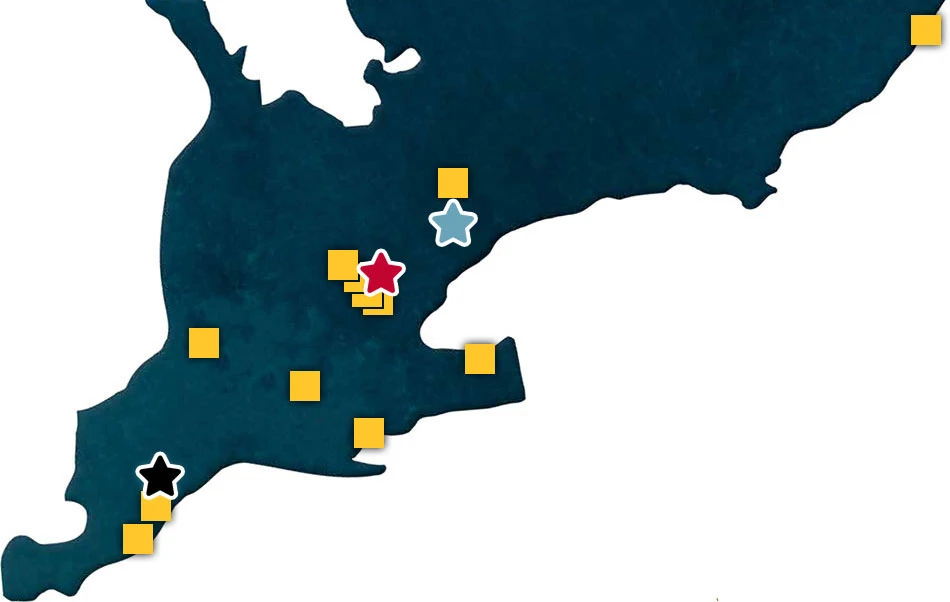
Ontario Agri-Food Innovation Alliance programs operate on the traditional, unceded and treaty lands and territories of First Nations and lands that are now home to diverse communities of First Nations, Inuit and Métis peoples. We acknowledge our responsibility to work alongside Indigenous Peoples.
Voices from the gathering
Art, community and environmental resilience were threads that ran through the day’s presentations and panel discussions.
Chandra F. Maracle delivered a keynote on the role of food in restoring and nurturing people, particularly new mothers, and shared her belly-cast artworks exploring the brain-gut connection and other themes.
U of G faculty, student researchers and community partners shared their work, weaving common threads among diverse disciplines such as environmental studies, history, health and nutrition, languages and literature, and geography.
Dr. Sue Chiblow shared the Anishinaabek Program of Research driven by and for Elders of the Robinson Huron Treaty territory. She highlighted the importance of Traditional Ecological Knowledge and the importance of reciprocity when doing research with Indigenous communities. Two of Chiblow’s students shared their research experiences as part of their Bachelor of Indigenous Environmental Science and Practice program.
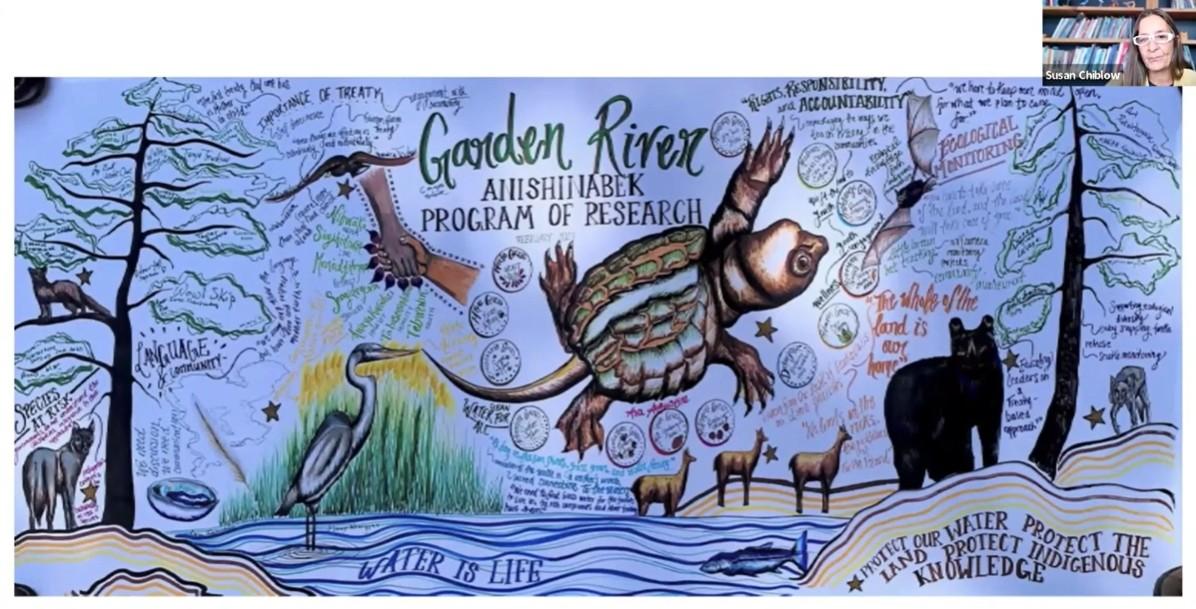
Garden River artwork created for the Anishinaabek Program of Research, led by Dr. Sue Chiblow. Artwork by Ava Augustine, University of Guelph.
Dr. Brittany Luby and master’s student Jane Mariotti presented on what fieldwork can teach us about community, stemming from their work on the resilience of manomin (“wild rice”), a culturally significant food plant within Treaty #3 territory in Northern Ontario.
Dr. Diana Lewis and members of the IndigenERA Lab hosted a discussion panel on environmental health, while professor Dr. Ashleigh Domingo and master’s student Teresa Copeland shared their research Minwanjigewin: Towards Food Security and Food Sovereignty with Williams Treaties First Nations.
Dr. Shauna Kechego-Nichols and Shania Simon, a learning developer with London Health Sciences Centre, spoke about human trafficking prevention with respect to Indigenous youth, who are intentionally targeted.
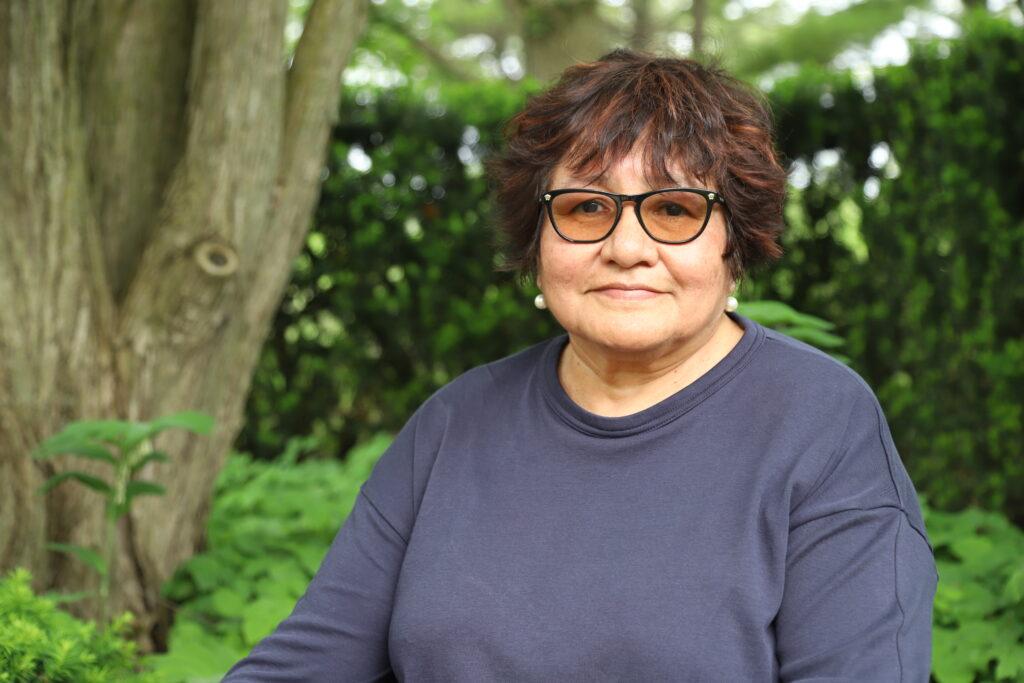
Highlights from the Alliance-funded Braiding Food Systems project
The panel discussion Braiding Knowledge and Practice for Indigenous Food Systems in Northern Ontario provided an update on the Braiding Food Systems Alliance Special Initiatives project. Moderated by lead researcher Dr. Silvia Sarapura, it highlighted how community-led initiatives are shaping food sovereignty and sustainability in Northern First Nations communities, with support from University of Guelph researchers and the Alliance.
Panel participants Kerri Commanda, Lorraine P. Cook, Dr. Michelle Seanor and Kellie Wrigley shared their experiences engaging communities around food security and sovereignty. A discussion around strengths of the project included teams developing cohesion and building confidence to see how they can excel, resulting in the initiatives going further. Key priorities for the future were identified as maintaining strong relationships and ensuring that knowledge flows back into communities.
Learn more about this project: Seeds Research – Join us to build resilient seed systems for a climate-changed world.
Participant and presenter feedback
After the event, participants were invited to respond to a follow-up survey. In the responses, participants shared enthusiasm and appreciation for the event, specifically the engaging speakers, diverse perspectives and research approaches, reflecting success in the event’s achieving objectives around connecting current research with the broader community.
In participants’ own words
“I really enjoyed the multiple perspectives and the research that is happening in this space. I liked how relevant the information was and how engaging the speakers were.”
“I found the Indigenous and agricultural topics discussed by Chandra were really insightful and a topic I find interesting to learn about.”
“There is much more going on than I had imagined and gives me hope and optimism for a more respectful, fair, unprejudiced future that is making gains towards reconciliation.”
“I really enjoyed that presenters ranged from seasoned professors, to applied practitioners, to students relatively new to Indigenous research. I thought this provided a wide range of perspectives, and is important for showing how people do and can engage with Indigenous research in a good way.”
"Thank you so much for inviting us to present! I’m grateful for the opportunity to share our work in this space."
"We’d like to extend a big congratulations to yourself, Cara and all of the organizers, presenters, and attendees for such a successful day. Thanks for all of your hard work and effort to plan and carry out the gathering. We are very grateful to have had the opportunity to share as a team yesterday and thank you for your flexibility in presentation format."
Open dialogue informing research
Participation reflected engagement from the public, government, academia and Indigenous organizations and communities.
The event met its goals of creating a dedicated space to mobilize knowledge, raise awareness, share approaches and barriers and build appreciation and understanding about Indigenous research.
In the future, organizers aim to encourage more Indigenous research and researchers in funding programs. As co-host Wehkamp noted in her closing remarks, “knowledge is not static; it is deeply evolving and connected to the land.”
This event was co-hosted by the University of Guelph and the Government of Ontario.