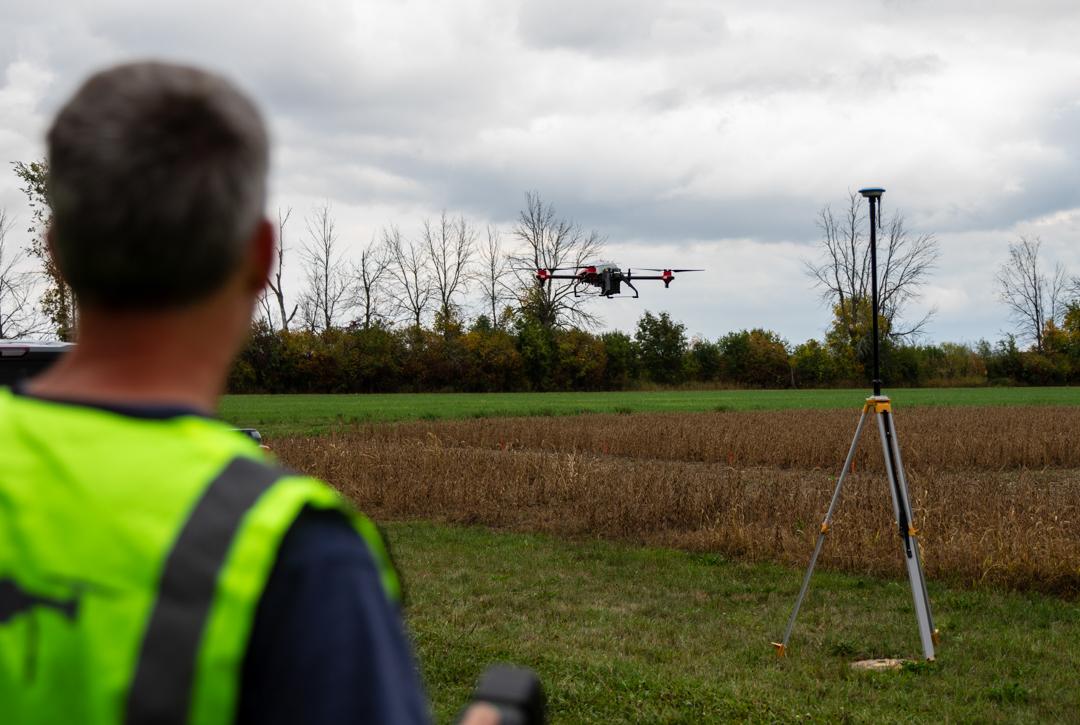
Each year DeSchiffart broadcasts the seed into plots that allow the team to compare different seeding times and rates.
A higher seeding rate is used with the drone compared to the drill.
“What surprised me is that establishment in the fall doesn’t compare to drill, it’s not uniform in a nice row. But every year in the spring, it fills out,” says DeSchiffart, noting that by spring some treatments achieve comparable yields to drilled wheat, or even higher yields with earlier seeding.
“When you broadcast, there might be fewer plants, but each plant is bigger,” says Nasielski, noting that soybean residue would need to be managed as well to ensure they don’t cause the wheat underneath it to die out.
The 2024 trial yielded slightly lower yields with broadcast seed versus drilling, but planting at the optimal time could lead to higher yields. Nasielski says this data is enough to warrant additional research.
Results from the 2025 trial using biopolymer-coated seed will be available in late summer 2026.