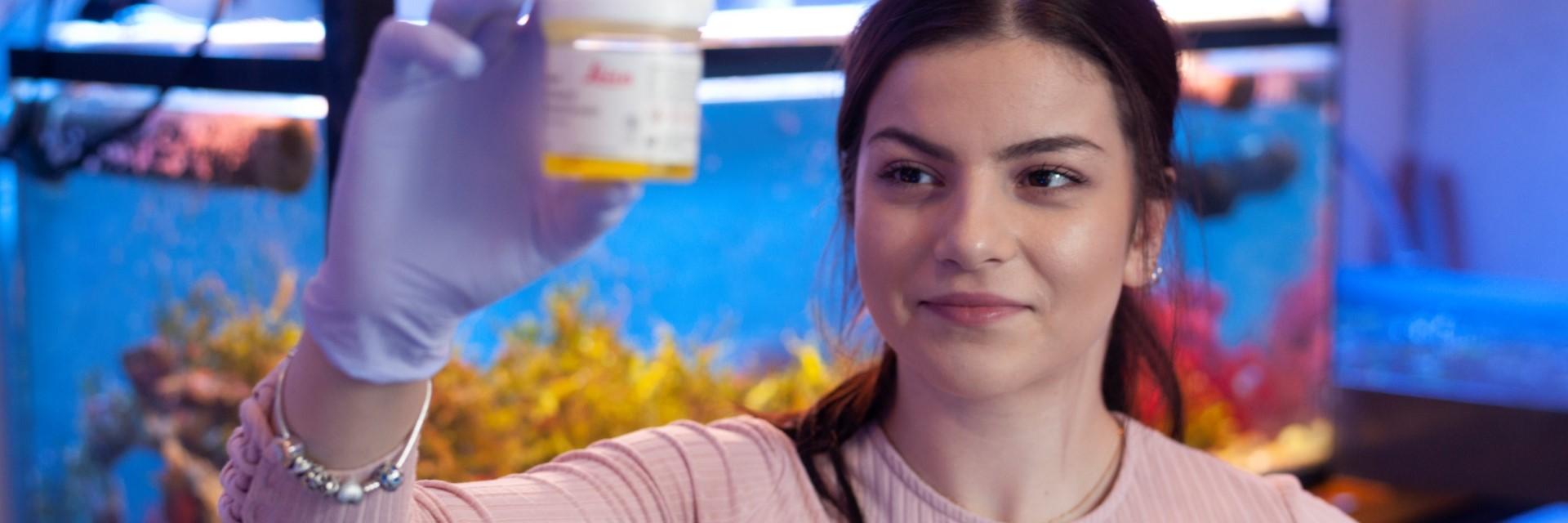
Marine and Freshwater Biology Co-op Student Information
About The Program
The Marine and Freshwater Biology co-op major provides a broad perspective on aquatic environments based on the physical as well as the biological sciences. Students build upon core courses in ecology, evolution, genetics, and physiology of aquatic biota as you study freshwater and marine environments and work with aquatic organisms experimentally in the field and in the lab. You will have the opportunity to perform independent research projects under a variety of field and laboratory conditions to enhance your learning experience and participate in co-op work terms to gain knowledge and skills in a workplace setting.
The Marine and Freshwater Biology major capitalizes on Guelph’s recognized excellence in aquatic research. The state-of-the-art Hagen Aqualab on campus allows researchers and students to simulate global aquatic environments and maintain a wide variety of marine and freshwater flora and fauna in Guelph. This program prepares students for post-graduate work in the aquatic sciences, and provides a sound scientific background for students pursuing careers in biology, management and conservation, aquaculture, biotechnology, education, and research in either government or private sectors.
Why Co-op?
As a co-op student, you will gain relevant work experience, build professional networks, and develop essential interpersonal skills needed to succeed in the workplace, all while getting paid and earning your university degree. Guelph’s co-op program is unique due to the exceptional level of support provided throughout the co-op experience. Students will complete a comprehensive course preparing them for the co-op employment process, and will receive guidance from a knowledgeable team of staff dedicated to their development and success.
Course Sequencing
| YEAR | FALL | WINTER | SUMMER |
|---|---|---|---|
| ONE | Academic | Academic | Off |
| TWO | Academic | Academic | Work |
| THREE | Academic | Work | Work |
| FOUR | Academic | Academic | Work |
| FIVE | Work | Academic |
Acquired Knowledge & Skills
Knowledge
Advanced understanding and appreciation of living aquatic organisms and specimens obtained through hands-on experience in the field and laboratory. Knowledge of the structure, function, and evolutionary relationships of the major taxonomic groups of aquatic organisms
Application
Ability to characterize and integrate the diversity of biological, chemical, and physical features that structure.
Sample Jobs
There is a diverse selection of jobs made available to Marine and Freshwater Biology co-op students, in government, academia, and the private sector within various industries. Students may conduct research, participate in literature searches, assist in data collection and analysis, and/or may collect, prepare, and analyze samples. Students may work in a laboratory, in the field, or in an office setting. Below are some examples of positions that may be held by Marine and Freshwater Biology co-op students:
Student Aquatic Science Technician
In this role, you will participate in field sampling of water, phytoplankton, zooplankton, and other limnological parameters aboard small and large vessels. You will also assist in the laboratory analyses of water samples, prepare reports and conduct data analysis.
Plant Health Research Assistant
You will assist in the establishment and care of marine plant studies in controlled environments, greenhouses, and outdoor trial facilities. You will be responsible for monitoring plants for signs of nutrient deficiency, stress, or disease over the course of the experiments and collect data on plant growth parameters.
Great Lakes Scientist
You will assist staff in the preparation and analysis of water quality and lake physical data collected in Great Lakes studies. You will work with project scientists contributing to the review of data quality, organization of lab and field data, exploratory statistical analysis, production of technical graphics and literature reviews on Great Lakes water quality questions.
Additional Sample Jobs: Water Garden and Aquatic Care Associate, Field Monitoring Assistant, Algal Monitoring Technician, Biomonitoring Technician
Sample Employers*
- Fisheries and Oceans Canada
- Ministry of the Environment and Climate Change
- Conservation Authorities, Nature Conservancies
- Trout Unlimited
- AQUALAB, University of Guelph
- Planet Shrimp
- AquaTox Testing & Consulting Inc.
*This shows a sample of recent co-op employers and will vary depending on employer recruitment needs. During a job search, students are encouraged to be actively engaged and are supported in establishing and maintaining their own personal contacts.
Salary Information
Students receive compensation from their employer for co-op work terms. The rate of pay will vary depending on a number of factors including the industry, the student’s program of study, and work term level. For your reference, a Co-operative Education Salary Guide is available on our website, which provides hourly rates (averages and ranges) for each degree program.