  • Employers & Partners
  • Hire a Co-op Student
  • Co-op Programs
  • Co-op Recruitment Timelines
  • Co-op Salary Guide
  • Co-op Student of the Year Award
  • Ethical Recruitment Guidelines
  • Hiring Incentives
  • Partner with a Course
  • Recruit Volunteers
  • Employer Information Sessions
  • Get the Word Out About Your Organization
  • Job & Career Fairs
  • Work Term Information for Co-op Employers
  • Current Students
  • Co-op
  • Co-op Forms
  • Career Education
  • Experiential Learning Opportunities
  • Find A Job
  • Get Support
  • Job & Opportunity Fairs
  • Volunteer
  • Your PCDR
  • Co-op Admission
  • Co-op Programs
  • Co-op Forms
  • International Co-op Students
  • Meet Us at Events
  • WEX
  • Alumni Services
  • Share Your Story
  • Faculty & Staff
  • Hire a Student
  • Offer an EL Course
  • Validate a Co-curricular Experience
  • Recruit Student Volunteers
  • Co-op Forms
  • Workshop Requests
  • Get EL Support & Resources
  • EL Hub Staff Login
PCDR
  • About Us
  • Staff Directory
  • AI Policy
  • About Experiential Learning
  • News
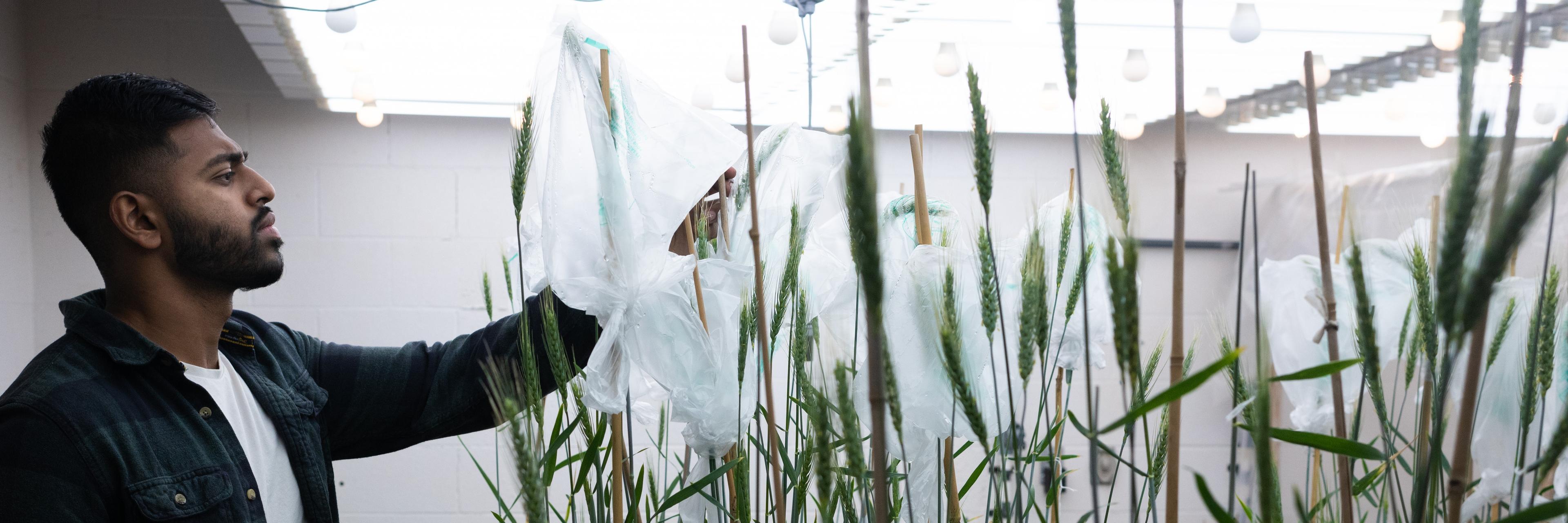
Person looks at plants indoors as part of an experiment.

Plant Science Co-op Information for Employers

  1. U of G Homepage
  2. Experiential Learning Hub
  3. Employers & Partners
  4. Co-op Programs
  5. Plant Science Co-op Information for Employers

Adding Value to Your Team

Students in the Plant Science major learn about the many wonders of plants, exploring the intricacies of plants through the study of their diversity, growth and development, plant-environment interactions, advances in molecular biology, and the various economic uses. Students in the program study alongside one of the largest concentrations of plant scientists in Canada, and gain hands-on knowledge of plant ecology, systematics, physiology, botany, genetics, agriculture, ethnobotany, and biotechnology.

Jump to section on page

  • Adding Value to Your Team
  • University of Guelph Advantage
  • Student Strengths
  • Co-op Work Term Schedule
  • Plant Science Course Sequencing

University of Guelph Advantage

The University of Guelph is an internationally top-ranked universaity with both Biological Science and Agricultural colleges. The Plant Science program crosses college boundaries to bring the full range of plant science programming to students. Guelph offers access to some of the world’s most respected scientists, teachers, and researchers as well as outstanding research and teaching facilities.

Students do not begin their first work term until they have completed 2 years of study and have mastered the core competencies needed to be successful in their work terms. Students are available for up to four work terms (4, 8, or 12 months) and employers can post, interview, and hire throughout the semester.

Student Strengths

Collaborative Problem-Solving

Strong problem-solving and collaboration skills while working alongside one of the largest concentrations of plant sciences in Canada.

Deep Understanding

In-depth knowledge in the role of ecological interactions of plants and their impact on global, cultural and societal issues in a professional working environment.

Practical Experience

Hands-on experience with advanced technology to explore plant ecology, systematics, physiology, botany, genetics, agriculture, ethnobotany and biotechnology.

Plant Science Co-op Work Term Schedule

YEAR

FALL

WINTER

SUMMER

ONEAcademicAcademicOff
TWOAcademicAcademicWork
THREEAcademicAcademicWork
FOURWorkWorkOff
FIVEAcademicAcademic

Plant Science Course Sequencing

Please see the current undergraduate calendar for more information.

Fall

  • Discovering Biodiversity
  • General Chemistry I
  • Effective Writing
  • Elements of Calculus I
  • Physics for Life Sciences

Winter

  • Introduction to Molecular and Cellular Biology
  • General Chemistry II
  • Physics for Life Sciences II
  • 1 Liberal Education elective
  • One of:
    • Introduction to Computing
    • Introduction to Programming
    • Elements of Calculus II

Fall

  • Introduction to Plant Agriculture
  • Introduction to Biochemistry
  • Life Strategies of Plants
  • Introduction to Co-operative Education
  • Foundations in Molecular Biology and Genetics
  • 1 Liberal Education elective

Winter

  • Molecular Biology of the Cell
  • Statistics I
  • 3 electives/restricted electives

Summer

Work Term One

Fall

  • Plant Functional Ecology
  • 4 electives/restricted electives

Winter

  • Plant Anatomy
  • Plant Growth and Development
  • 3 electives/restricted electives

Summer

Work Term Two

Fall

Work Term Three

Winter

Work Term Four

Fall

  • 3–4 electives/restricted electives
  • One of:
    • Research Project I
    • Research in Integrative Biology I
    • Research Project in Molecular and Cellular Biology I
    • Topics in Molecular and Cellular Biology

Winter

  • Metabolism in the Whole Life of Plants
  • 4 electives/restricted electives
Restricted Electives

Restricted electives include: a minimum of 1.00 credits of Liberal Education and a minimum of 2.00 credits of Core electives and 3.00 credits of Subject Area electives from the following disciplines:

  • Applied Plant Science
  • Plant Biotechnology and Plant Genetics
  • Plant Ecology and Evolution
  • Research Methods

See Undergraduate Calendar for list of Core and Subject Area electives.


Learn More About Co-op at Guelph
U of G Experiential Learning

About Us

The Experiential Learning Hub is home to experiential learning opportunities on and off-campus, co-op, career education and community engaged learning.

Visit Us

Our commitment to accessibility

Sign up for our weekly e-news

Contact Us

Experiential Learning Hub

University of Guelph
50 Stone Rd E
Trent Lane Building 54
Guelph, ON N1G 2W1
519-824-4120, Ext. 52323
recruit@uoguelph.ca