MSc & PhD in Plant Agriculture (Thesis/Research)
Research the cornerstone of life on earth.
The M.Sc. and PhD in Plant Agriculture are offered through the Department of Plant Agriculture, a research-intensive department focused on horticultural crops, turfgrass, landscape species and field crops. Research in the department is divided into four areas: Plant Biochemistry and Physiology, Plant Breeding and Genetics, Crop Production Systems, and Bioproducts.
Best in Canada
Study in Canada’s largest and most diverse applied plant biology department.
Elevate your impact
Broaden your high-paying career options by achieving a graduate degree. M.Sc. and Ph.D. graduates in plant science are highly sought after by Canadian and international employers.
Research-based studies
Alongside faculty members and other students, you will develop, conduct and publish impactful research focused on your area of plant interest.
Excellent facilities
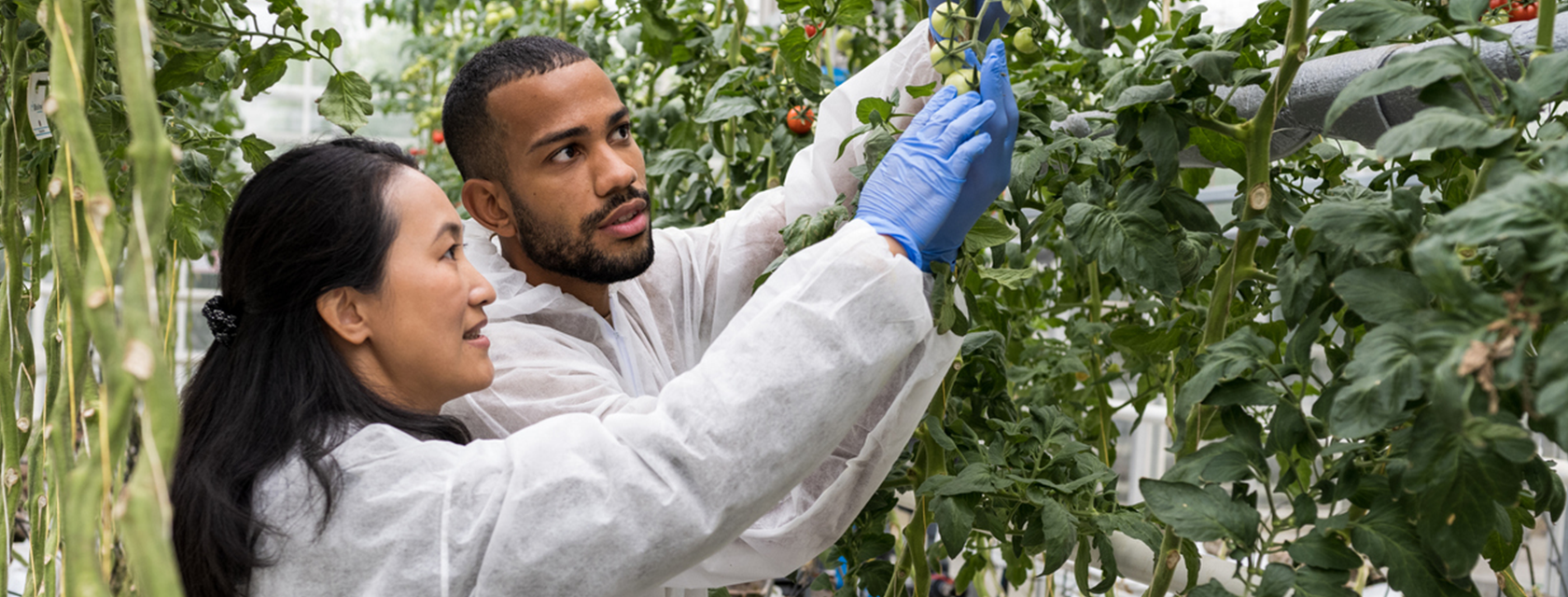
Conduct your research in excellent research facilities and equipment, including plant growth facilities, plots, fields and greenhouses.
Leading research centres
Work alongside and in the Bioproduct Discovery and Development Centre, Guelph Centre for Urban Organic Farming, Gosling Research Institute for Plant Preservation, Controlled Environment Systems Research Facility, and Guelph Turfgrass Institute.
Research plots across Ontario
Access 17 field research stations (multiple soil types and heat unit zones) across Ontario.
This program is offered in-person at either our Guelph campus or Ridgetown Campus, depending on your supervising faculty member.

More information on courses and admission requirements can be found here.
Hear from Our Alumni and Professors

Being an international student, I found the faculty to be very supportive. They assist each student by designing a career path to help shape their future.

I work mostly on diseases and some of them can lead up to one-hundred percent crop loss, so it's really important to have effective environmentally friendly, sustainable methods to manage those risks to crops.

The biggest advantage of being stationed at the Ridgetown Campus is that the research facilities, the research land, all the equipment that we use, is within minutes of our offices and the buildings that we work out of. It allows us to be very flexible with establishment of our research studies.

Graduate students in my lab work on a wide range of things. Some are working on regeneration from single cells. Some are working on optimizing conditions for medicinal plant production. Some are working on conservation of endangered species. It's important to preserve plants because with climate change, a lot of them are facing the threat of extinction.
How to Apply
As part of the application requirements, you are required to secure a faculty advisor to supervise your program. Our faculty profiles describe research programs in more detail and can be found in the Department of Plant Agriculture website. Contact the faculty member you are interested in working with to discuss potential research opportunities. We recommend connecting via email.
Contact
For questions on applying and admissions, contact:
Tara Israel
Department of Plant Agriculture
pagrad@uoguelph.ca
519-824-4120, Ext. 56077
For questions on graduate program options, contact:
Leigh West
Ontario Agricultural College (OAC)
lewest@uoguelph.ca
519-824-4120 Ext. 52101