Become a leader in food, agricultural and resource economics.
The MSc and PhD in Food, Agricultural and Resource Economics (FARE) are offered through the Department of FARE with two key areas of study: 1) Food and agricultural economics, and 2) Natural resource and environmental economics. Both programs are focused on developing a fundamental understanding of economic principles and their application to agricultural, resource, rural and related issues through research. Problem identification, conceptualization skills, and communication skills are also an important area of development.
Study in Canada’s top agricultural economics program in the Department of Food, Agricultural and Resource Economics at the University of Guelph.
Elevate your impact
Broaden your career options by achieving a high-quality graduate degree and improve your ability to make a difference in the world.
Research-based studies
Alongside faculty members and other students, you will develop, conduct and publish impactful research in your area of plant interest.
Collegial environment
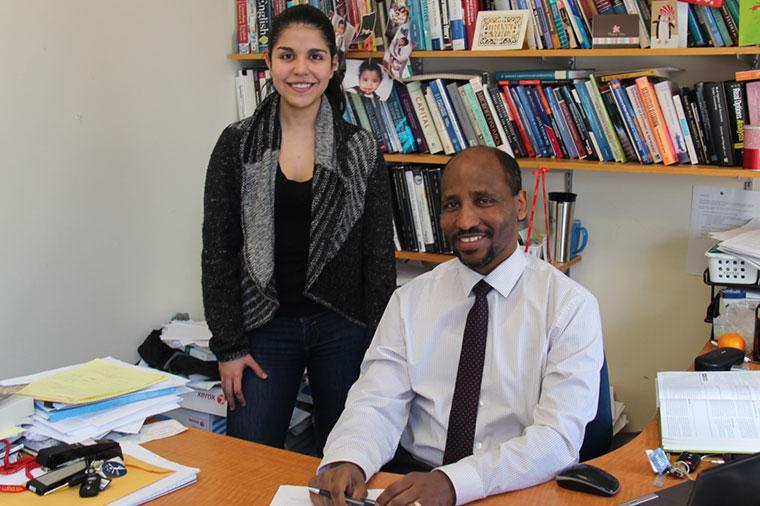
Join a department dedicated to providing you with a superior learning experience. You will be treated as a colleague, receive significant one-on-one attention and given challenging and rewarding opportunities.
Rigorous economics training
Receive a well-rounded education through a combination of economic theory, quantitative methods, agricultural economics subject matter and applied research experience.
Explore your options
Securing a faculty advisor is not required for application. You will select an advisor during the first two semesters of the program providing you time to explore your research and learning options.
Methodologies of Econometrics
International Food Sector and Policy Analysis
Natural Resource Economics
Applied Policy Analysis
Agricultural Trade Relations
Food Firms, Consumers and Market
Applied Microeconomics for Agricultural Economists
Applied Quantitative Methods for Agricultural Economists
My research looks at the effect of government policy or new technology on what farmers decide to do and the impacts of those decisions on the structure of agriculture.
Dr. Alfons Weersink, FacultyProfessor, Department of Food, Agricultural and Resource EconomicsHear more from Dr. Weersink
The most exciting aspect of my work is that it brings insights into how agribusiness firms operate in the world of uncertainty, not just in food prices, but also in the broader context of business climate and policy.
Dr. Yu Na Lee, FacultyProfessor, Department of Food, Agricultural and Resource EconomicsHear more from Dr. Lee
I study natural resources, particularly water and land, and the allocation of those resources. This is particularly important and exciting because these are fundamental to the health, wealth and economic development of most regions around the world.
Alongside a couple of my graduate students I have a program of research that looks at the economics of animal welfare and what we're trying to understand is consumer acceptance and willingness to pay for food products that come from an agricultural production system where there is enhanced animal welfare characteristics.
Dr. John Cranfield, FacultyProfessor, Department of Food, Agricultural and Resource EconomicsHear more from Dr. Cranfield
Students entering the M.Sc. program must have achieved the University required minimum 70% (B-) average or equivalent. Based on our experience, successful applicants tend to have a higher GPA, closer to 75% or Upper Second Class.
You are expected to have already taken, the following basic courses:
Intermediate level micro- and macro-economic theory (ECON*2310 and ECON*2410 or equivalent); Advanced microeconomic theory course at the undergraduate level is strongly recommended as preparation for the course work in the MSc program.
Calculus and matrix algebra with applications to economics (ECON*2770 or equivalent)
Intermediate level statistics (ECON*3740 or equivalent)
As international grading scales and minimum requirements do vary, please consult the "International Credential Evaluation Guidelines". Applicants must note that depending on their academic background obtained from some countries including Pakistan, Bangladesh, or India, they are required to hold both a Bachelor degree and a Masters degree at the First Class/First Division Level to be eligible for the MSc program.
If your first language is not English, you will be required to submit the results of a standardized language test. Please see chart below for acceptable tests and required scores for the Department of FARE. The University of Guelph English as a Second Language Test Code is 0892. Acceptable tests and minimum required scores for FARE graduate programs are:
International English Language Testing System (IELTS) = 7.0 overall score and a minimum score of 6.5 in the Speaking and Writing category
Test of English as a Foreign Language (TOEFL)
TOEFL - Paper based test (PBT) = 587
TOEFL - Internet based test (IBT) = 95
NOTE: A minimum overall score of 95 must be achieved, with at least 22 in Speaking, 26 in Writing and 21 in the Listening and Reading categories.
University of Guelph Language Certificate = Advanced Level
NOTE: English as a Second Language tests are considered valid for a period of two years. You may upload a letter requesting exemption from this requirement if you have completed your academic studies in a recognized English speaking institution. Please indicate institution, program and length where all were delivered in English.
Students entering the Doctoral program require a minimum average of B or 73% in the last two years of study and completion of a Bachelor’s degree. (Note: most successful applicants have an average of 80%, A- or higher.) Students entering the PhD program are expected to have satisfied the requirements, or their equivalents, (contains significant mathematics components and several economic theory courses) of the department's MSc degree in Food, Agricultural and Resource Economics. Refer to Office of Graduate & Postdoctoral Studies for university guidelines
Graduate Record Examination (GRE - General only) scores are required for ALL doctoral applications. Institution code is 0892 and the Department code is 0101 Agricultural Economics.
In cases where a student's master's degree is not equivalent to that offered by the department, the student may initially be accepted into the MSc program and may then apply for transfer to the PhD program at some time during the first three semesters. Applications for transfer must be supported by the Departmental Graduate Program Committee and approved by the Board of Graduate Studies. The student does not have to complete all the requirements of the MSc before transferring to the PhD program, but must achieve high academic standing.
If your first language is not English, you will be required to submit the results of a standardized language test. Please see chart below for acceptable tests and required scores for the Department of FARE. The University of Guelph English as a Second Language Test Code is 0892. Acceptable tests and minimum required scores for FARE graduate programs are:
International English Language Testing System (IELTS) = 7.0 overall score and a minimum score of 6.5 in the Speaking and Writing category
Test of English as a Foreign Language (TOEFL)
TOEFL - Paper based test (PBT) = 587
TOEFL - Internet based test (IBT) = 95
NOTE: A minimum overall score of 95 must be achieved, with at least 22 in Speaking, 26 in Writing and 21 in the Listening and Reading categories.
University of Guelph Language Certificate = Advanced Level
English as a Second Language tests are considered valid for a period of two years. You may upload a letter requesting exemption from this requirement if you have completed your academic studies in a recognized English speaking institution. Please indicate institution, program and length where all were delivered in English.
In addition to the general University admission requirements, application to FARE's graduate programs require:
CV or Resume
Transcript(s) and grading scale
Statement of Research: provide a one to two-page outlining your research interest and why you wish to pursue graduate studies
References: Two academic references are required; a third professional reference is optional
GRE (general section - PHD applicants only): Allow time to complete to meet application deadline; upload your results along with your Statement of Research
January 31, 2027 for International Students*
March 31, 2027 for Domestic Students
We encourage international and domestic applicants to complete your application early to ensure that all documents are received by the deadline. Due to the electronic application process, you should allow a minimum of two weeks to work through the process to complete your application
Dr. Sylvanus Kwaku Afesorgbor safesorg@uoguelph.ca 519-824-4120 ext. 53169
Questions on program admissions? Contact:
faregrad@uoguelph.ca 519-824-4120 ext. 52771
What Students Have to Say
I enjoy seeing the whole picture, asking the bigger questions, and getting involved with multiple areas instead of specialization. Specialization is undeniably valuable, but so is a better understanding of the bigger puzzle that we are looking at and how everything is interconnected.
Livia Sente, Graduate StudentMSc in Food, Agricultural and Resource EconomicsHear more from Livia
"When I talk to friends from other universities it always makes me realize how much U of G has to offer – personable and engaging professors, opportunities for involvement, and both a school and city with a real community focus. Pursuing graduate studies at U of G was an easy decision for me."
Danielle Roy, Graduate StudentMSc in Food, Agricultural and Resource EconomicsHear more from Danielle
I had a wonderful experience in the department. I felt that the program offered a diverse perspective on interrelated subject areas, particularly agriculture and the environment in my case. I feel that the research being done in the department is timely and significant. I think that the seminars, research symposia and conferences provide students with invaluable experience and networking opportunities. The faculty devote an immense amount of time and attention to the students they advise.